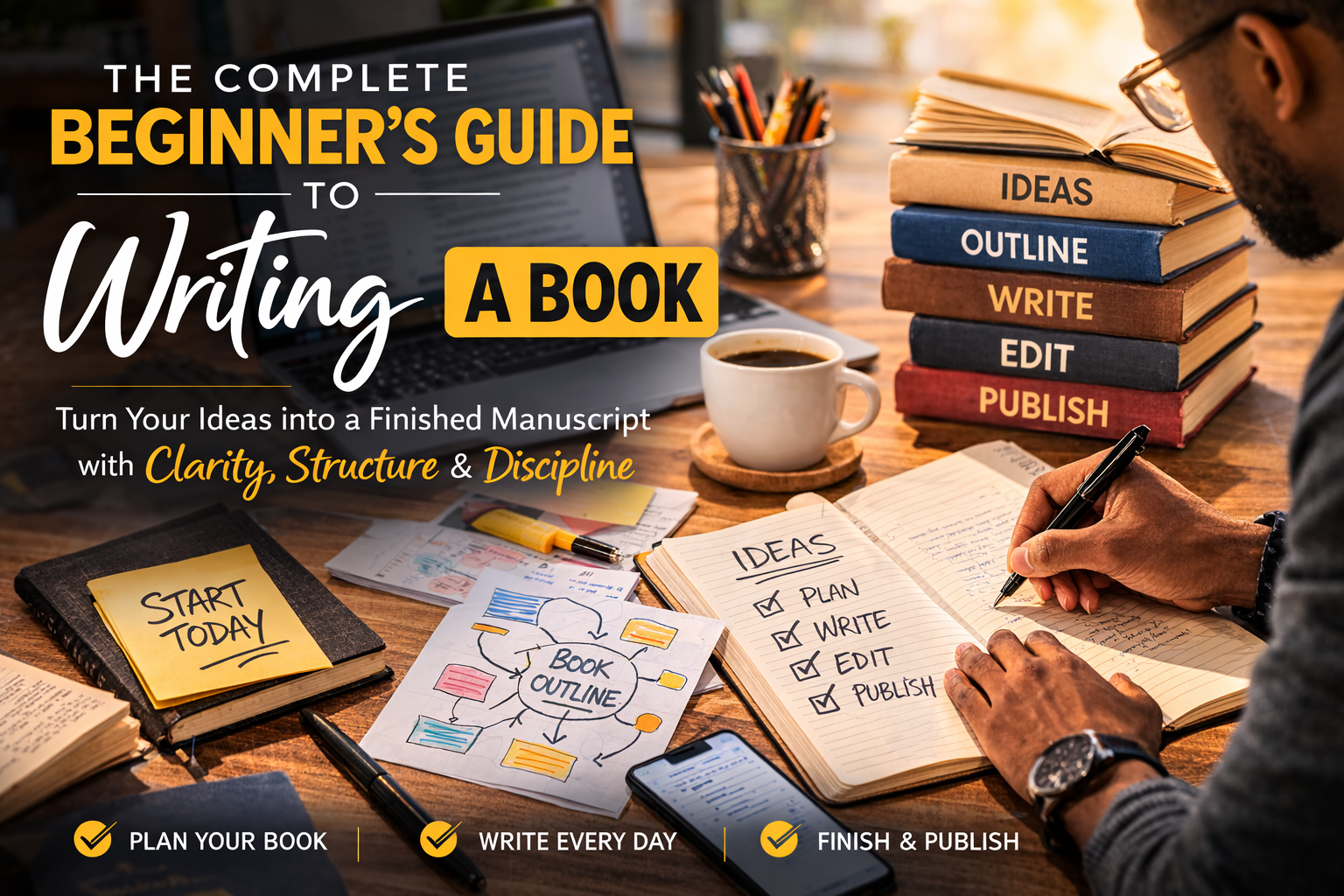
The Complete Beginner’s Guide to Writing a Book
Many people dream of writing a book, but only a small number actually complete one. Writing a book requires more than inspiration—it requires structure, discipline, and a clear writing process. This guide explains how to move from idea to finished manuscript step by step.

Why Writing a Book Still Matters
Books remain one of the most powerful ways to share knowledge, wisdom, stories, and experiences. While technology has transformed how information is distributed, books continue to hold unique authority. A well-written book allows authors to communicate ideas with depth, clarity, and lasting impact.
Many aspiring writers hesitate to begin because the process appears complex. However, learning how to write a book becomes much easier when the process is broken into clear steps. Writing a book is not a mysterious talent reserved for a few—it is a skill that can be developed through discipline, planning, and consistent effort.
If you are new to writing, explore more Writing Tips to strengthen your discipline, improve clarity, and grow in confidence as an author.
Step 1: Start With a Clear Book Idea
Every book begins with an idea. Some books begin with a story, while others start with a message, a lesson, or a problem that the author wants to help readers solve. The important thing is to clarify the central purpose of the book before writing begins.
Ask yourself these important questions:
- What is the main message of this book?
- Who is the intended reader?
- What transformation should the reader experience?
- Why is this book important?
Clarity at this stage helps guide the entire writing process. When authors understand their purpose, they write with greater direction and confidence.
If you want practical guidance for your writing journey, explore our For Authors page for helpful support and direction.
Step 2: Identify Your Target Reader
Successful books are written for specific readers. Instead of trying to write for everyone, strong authors focus on serving a clearly defined audience.
For example, your readers might be:
- entrepreneurs
- young professionals
- students
- parents
- leaders
- people seeking personal or spiritual growth
Understanding your reader helps determine the tone, structure, and depth of your writing. When authors write with a specific audience in mind, their books become more relevant, practical, and engaging.
Step 3: Create a Simple Book Outline
One of the most important book writing tips is to develop an outline before writing the manuscript. An outline provides structure and helps prevent writers from becoming overwhelmed by the size of the task.
A simple book outline may look like this:
- Introduction
- Chapter 1: The Problem
- Chapter 2: Understanding the Issue
- Chapter 3: Key Principles
- Chapter 4: Practical Applications
- Chapter 5: Long-Term Growth
- Conclusion
An outline does not need to be perfect. It simply provides a roadmap that helps writers move forward with confidence and avoid unnecessary confusion.
Step 4: Develop a Consistent Writing Routine
Many aspiring writers never complete their books because they wait for inspiration. Professional authors understand that writing requires consistency more than occasional motivation.
A daily writing habit is one of the most reliable ways to finish a manuscript. Even writing 500 words per day can produce a complete book within a few months.
Helpful writing practices include:
- setting a daily writing goal
- choosing a consistent writing time
- eliminating distractions
- focusing on progress rather than perfection
If you are building your writing rhythm, you may also find value in browsing more articles under Writing Tips.
Step 5: Write the First Draft Without Perfection
One of the biggest mistakes beginners make is trying to write perfectly during the first draft. Writing and editing are different stages of the creative process, and they should not be forced into the same moment.
The purpose of the first draft is simply to complete the manuscript. Perfection can come later through editing and revision.
When learning how to start writing a book, it is important to remember that every strong book begins as an imperfect draft that is improved over time.
Step 6: Revise and Strengthen the Manuscript
After completing the first draft, the next stage is revision. Editing helps improve clarity, structure, tone, and readability.
During the revision stage, authors often:
- remove unnecessary sections
- clarify explanations
- improve chapter transitions
- refine language and tone
Editing transforms a rough manuscript into a more polished and professional book. This stage is where your message becomes sharper and easier for readers to follow.
Step 7: Prepare the Book for Publishing
Once the manuscript is complete, the next step is preparing the book for publication. This stage often includes formatting, cover design, proofreading, and distribution decisions.
Many modern authors choose the independent publishing route because it provides greater flexibility and creative control. You can learn more by exploring our Self-Publishing category.
If you need professional support, you can also explore WordCraft Publishing Services for assistance with your publishing journey.
Step 8: Build Your Author Identity
Writing a book is only the beginning of the author journey. Successful authors also build visibility, credibility, and a recognizable message around their work.
Developing your author identity helps readers understand your voice and connect with your books more easily. To grow in this area, explore our Author Branding category.
You may also want to learn more about the vision behind the publishing platform by visiting the About WordCraft page and the Author page.
Writing a Book Is a Journey of Discipline and Purpose
Writing a book is not merely an intellectual exercise. It is a journey of discipline, creativity, and purpose. Authors who complete books often discover that the process not only produces a manuscript, but also deepens their understanding of the message they are called to share.
Many successful authors began with uncertainty, but they progressed one step at a time. The key is to start with a clear idea, develop a workable plan, and remain consistent in the process.
If you are serious about writing and publishing, you may also explore the growing collection of titles available through WordCraft Books.
Conclusion
Learning how to write a book becomes much easier when the process is approached step by step. Begin with a clear idea, develop an outline, write consistently, and refine the manuscript through careful editing.
Every completed book begins with a simple but powerful decision—to start writing.
To continue growing as a writer, explore more resources on WordCraft Publishing, visit FreedomHub for broader personal growth insights, and browse Freedom Centre International for faith-based teaching and encouragement.
Ready to move from idea to published book?
Explore our author resources, browse publishing services, and discover more practical guidance through Writing Tips, Self-Publishing, and Author Branding.
You can also contact WordCraft Publishing for support on your writing and publishing journey.
Leave a Reply