How to Structure a Nonfiction Book That Readers Will Finish
Many nonfiction books fail not because the ideas are weak, but because the structure is unclear. A strong book structure helps readers follow the message, stay engaged, and understand the ideas clearly.

Many authors struggle not because they lack insight, but because they have not yet learned how to structure a nonfiction book in a way that carries readers from one idea to the next. A strong structure turns good content into an enjoyable reading journey.
Whether you are writing a self-help guide, leadership book, faith-based teaching, memoir with lessons, or educational handbook, the structure of your manuscript determines whether readers feel guided or lost. When your material is organized clearly, readers are more likely to trust the message, stay engaged, and reach the final chapter.
Why Book Structure Matters
A clear structure gives your nonfiction book momentum. It helps readers understand where they are, what they are learning, and why each chapter matters. Without structure, even valuable ideas can feel repetitive, scattered, or difficult to apply.
Simple truth: strong ideas may attract readers, but strong structure keeps them reading.
A strong structure helps you:
- guide the reader from problem to solution;
- build each chapter on the previous one;
- make your message easier to understand and remember;
- increase the likelihood that readers will finish the book.
If you want to grow as an author, explore more practical guidance in our Writing Tips section.
Start With a Clear Book Purpose
Before you build your nonfiction book outline, define the central purpose of the book. Every strong structure begins with clarity. Ask yourself what the book is meant to accomplish for the reader.
Here are three foundational questions:
- What problem is this book solving?
- What transformation should the reader experience?
- What one message must the reader remember after finishing?
Your answers will shape the order of your chapters, the depth of your explanations, and the examples you choose. A book without a clear purpose often feels informative but not truly compelling.
Create a Logical Nonfiction Book Outline
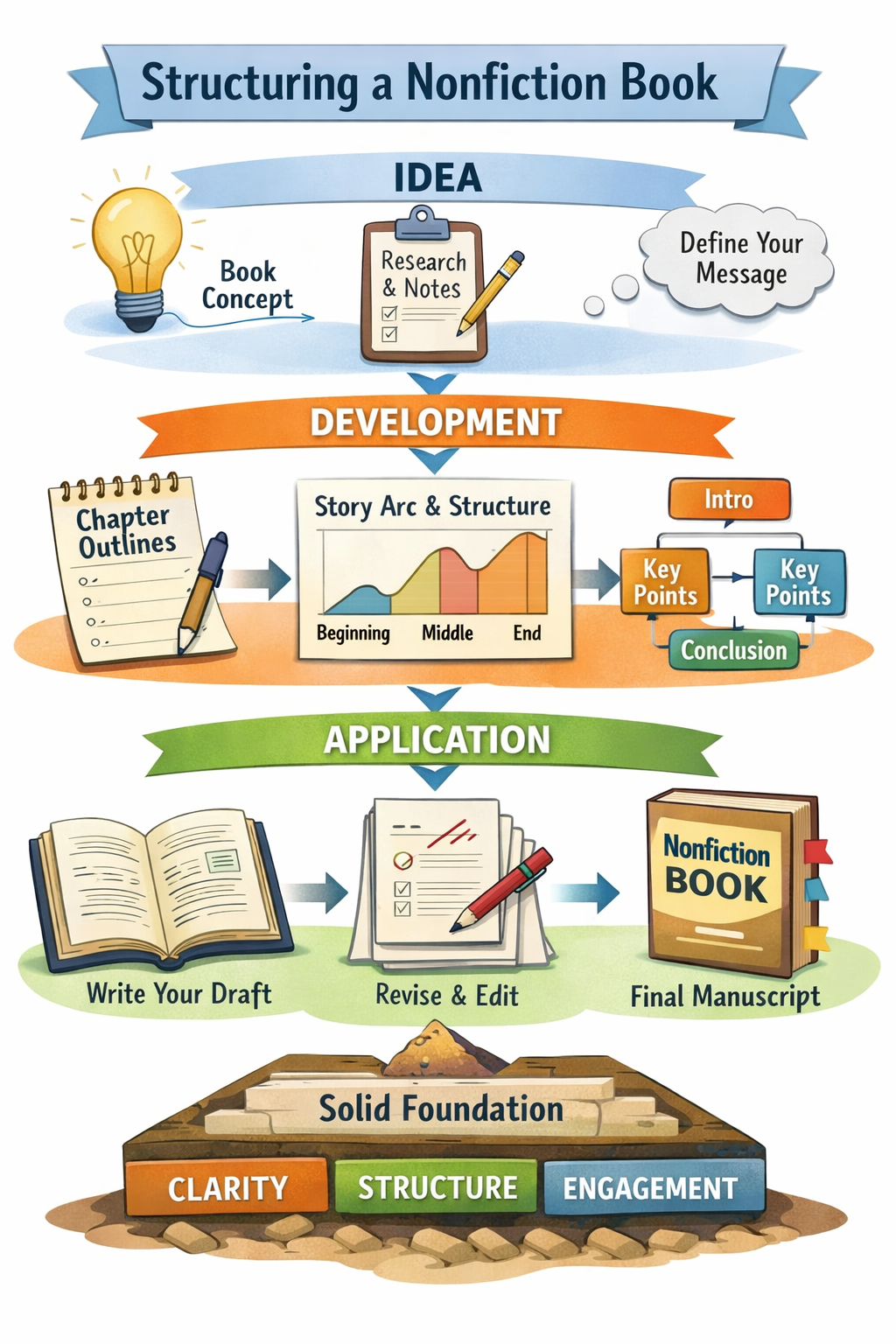
One of the best book structure tips is to build your manuscript around a simple and logical framework. Most effective nonfiction books follow a three-part progression: foundation, development, and application.
Part 1: Foundation
Introduce the reader’s challenge, define the topic, and explain why the subject matters. This section sets the stage for everything that follows.
Part 2: Development
Present the core teaching, strategy, framework, or insight. This is where the central value of your book is delivered chapter by chapter.
Part 3: Application
Show the reader how to act on what they have learned through action steps, reflection questions, implementation plans, or practical exercises.
This framework works especially well for authors who are writing nonfiction books that aim to teach, coach, equip, or inspire change.
If you are also preparing your manuscript for release, visit our Publishing Tips category for the next stage of the journey.
Organize Chapters for Clarity
Each chapter should have its own internal order. Readers should never wonder why a chapter exists or how it connects to the overall message of the book.
A practical chapter structure often looks like this:
This approach makes your content easier to follow and helps readers stay engaged. It also improves readability for digital audiences who often scan before reading deeply.
Maintain Logical Progression
A good nonfiction book should feel like a guided journey. Each chapter must naturally lead into the next one. The reader should sense progress, not random movement.
A strong progression often looks like this:
- Define the problem.
- Explain the root causes or key principles.
- Present the framework or solution.
- Show examples or case studies.
- Offer action steps for implementation.
Helpful Writing Principle
Before finalizing your outline, ask of every chapter: What question does this chapter answer, and which question does it create for the next one?
To better understand how audiences read and respond to content, explore our Reader Insights resources.
Avoid Common Structure Mistakes
Many nonfiction books lose readers because of a few common and avoidable structural mistakes. Identifying these early can save your manuscript from becoming difficult to read.
1. Overloading Chapters
Trying to teach too many ideas in one chapter weakens clarity. Give each chapter one clear job.
2. Repeating the Same Point
Reinforcement is useful, but repetition without fresh insight causes the book to feel padded.
3. Weak Transitions
If chapters do not connect smoothly, readers feel the breaks. Use short bridge paragraphs to show how one chapter leads to the next.
4. No Practical Application
Readers of nonfiction usually want more than ideas. They want understanding they can use. End chapters with action, reflection, or implementation where appropriate.
Use Frameworks and Models
Readers love structure inside the structure. Frameworks, models, and step-by-step systems help them absorb complex ideas more easily. They also make your book more memorable and quotable.
Frameworks can include:
- three-step or five-step processes;
- diagnostic models;
- before-and-after comparisons;
- chapter-end action plans;
- visual diagrams and summary tables.
A strong framework gives the reader handles to hold. It turns your message from abstract information into a practical tool.
End With a Strong Conclusion
The conclusion should do more than summarize. It should reinforce the central message of the book and help the reader leave with clarity, confidence, and direction.
A strong final section should:
- restate the main transformation of the book;
- summarize the most important principles;
- encourage immediate application;
- leave the reader with momentum rather than mere information.
Many successful nonfiction books finish with an implementation guide, checklist, personal reflection, or action plan. This helps readers move from reading to doing.
Final Thoughts
Learning how to structure a nonfiction book is one of the most valuable skills an author can develop. A well-structured manuscript creates clarity, builds trust, supports reader engagement, and increases the likelihood that people will finish the book and benefit from it.
Before writing your next manuscript, take time to design the reading journey carefully. Clear structure is not a decorative extra. It is one of the foundations of an effective nonfiction book.
Keep Building Your Author Platform
Strong writing deserves strong publishing support. Continue strengthening your craft, book planning, and publishing readiness through the resources below.
Leave a Reply